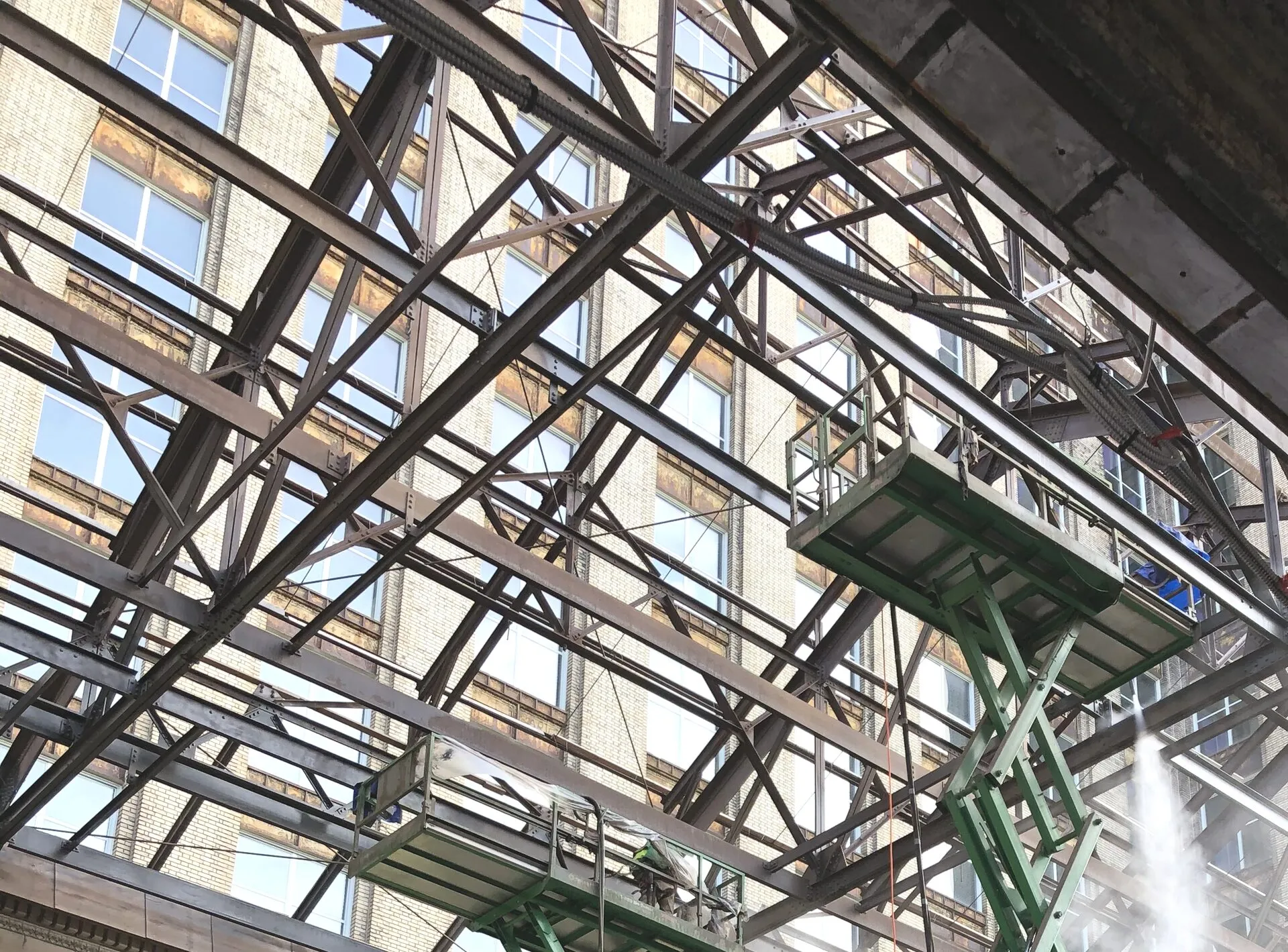
A lot of the steel in Michigan’s water plants, wastewater facilities, tanks, and industrial sites was coated with coal tar decades ago. Coal tar enamel, coal tar epoxy, Bitumastic — it was the go-to for anything wet or buried for most of the last century.
A lot of that coating is now at the end of its life. And when it’s time to recoat, especially if the asset is being converted to potable service or the owner has phased coal tar out, the old coal tar has to come off. That’s a different job than blasting off ordinary paint.
Why Coal Tar Removal Is Different
It’s a health hazard. Coal tar and coal tar pitch are classified as known human carcinogens. Blasting coal tar breaks it into fine dust and releases coal tar pitch volatiles, the compounds OSHA regulates with a permissible exposure limit (PEL) of 0.2 mg/m³. Skin contact is a concern too — coal tar can cause skin irritation and photosensitivity, where exposed skin burns in sunlight.
It’s thick and it’s soft. Coal tar enamels and mastics can be very thick, and they’re gummy compared to hard epoxies. Abrasive tends to bounce off or embed instead of cutting, especially in warm weather when the coating softens.
It rarely comes alone. Older coal tar systems were often applied over, or under, lead-based primers. Many older tanks and structures have layers from different decades. What’s on the steel needs to be tested before anyone blasts it. See Lead Paint Abatement and Industrial Blasting.
Removal Methods
Abrasive blasting. The most common method for getting to a clean surface with a profile, ready for recoating. It works best with a sharp, aggressive abrasive and enough pressure and nozzle size to cut through the film. On thick or gummy coatings, cold weather actually helps — coal tar gets brittle and fractures off more cleanly. Blasting ends with the SSPC grade the new coating needs, usually SSPC-SP 10 or SP 5 for immersion service.
Ultra-high-pressure (UHP) water jetting. At 40,000 PSI, UHP water jetting strips thick coatings well, keeps dust down, and doesn’t add spent abrasive to the waste stream. It does not create an anchor profile, so if the steel’s old profile isn’t usable, you blast after. More in 40,000 PSI Water Blasting for Coating Removal.
Mechanical removal. Scraping and power tools for small areas, edges, and tie-ins. Slow on large areas and doesn’t produce the profile most replacement coatings need.
In practice, many jobs combine them: UHP to take off the bulk of a thick coating with less dust, then abrasive blasting to reach the cleanliness grade and profile.
Protecting the Crew
Coal tar removal needs a written exposure control plan, just like lead or silica work:
- Respiratory protection matched to measured exposure levels — typically supplied-air blast hoods for abrasive blasting
- Containment and ventilation to keep dust and vapors away from other workers and the public
- Full skin coverage, including gloves, coveralls, and face protection, to prevent coal tar dust contact
- Hygiene facilities — wash stations and a clean change area so contamination doesn’t go home on skin or clothing
- Air monitoring to confirm exposures are below OSHA limits
- Silica controls if the abrasive or substrate contains silica — see OSHA’s Silica Dust Standard
Inside tanks and pipe, all of this is on top of OSHA confined space requirements.
Waste Handling
Spent abrasive mixed with coal tar — and possibly lead — needs to be collected, stored, and characterized before disposal. That usually means TCLP testing to find out whether the waste is hazardous. The answer changes the disposal cost a lot, so it belongs in the budget before the job starts, not after.
Contain the blast area, collect spent media daily, and keep it out of storm drains, soil, and water. On waterfront and wastewater jobs, that’s where most of the risk is.
What Goes Back On
What replaces coal tar depends on the service:
Potable water tanks and pipe. An NSF/ANSI 61 certified lining — usually a liquid epoxy per AWWA C210 for steel pipe, or an NSF 61 tank lining system. Coal tar can’t go back on. Details in Can You Use Bitumastic on Potable Water Pipe?
Buried and submerged non-potable steel. Coal tar epoxy is still allowed on many of these jobs. Many owners now choose high-build non-coal-tar epoxies for similar performance without the coal tar exposure concerns for future maintenance crews.
Wastewater and sewer structures. High-build epoxies, novolac epoxies for aggressive H2S service, and polyurea or polyurethane linings are all common replacements.
Above-grade steel that was coated with coal tar. It never should have been — coal tar breaks down in sunlight. A zinc primer, epoxy intermediate, and polyurethane topcoat system is the standard replacement for atmospheric steel.
Whatever goes back on, the prep requirement is set by the new coating’s data sheet, not the old one.
Planning the Job
Before you bid or schedule coal tar removal, get these nailed down:
- Test the existing coating for coal tar, lead, and other metals.
- Choose the removal method based on thickness, access, dust limits, and what profile the new coating needs.
- Write the exposure control plan — respirators, containment, hygiene, monitoring.
- Plan waste handling and budget for TCLP testing and possible hazardous disposal.
- Confirm the replacement coating and its SSPC prep grade and profile.
- Schedule around weather — coal tar strips easier cold, but most replacement coatings need warmer steel and low humidity to go on.
Coal tar removal is dirty, hazardous work. Done with the right plan, it’s also a one-time job — the last time that steel ever has coal tar on it.
Blasting Jack removes old coal tar, Bitumastic, and multi-layer coatings from pipe, tanks, and structural steel across Michigan using abrasive blasting and 40,000 PSI water jetting, with containment and exposure controls. Contact us to plan your coating replacement project.